


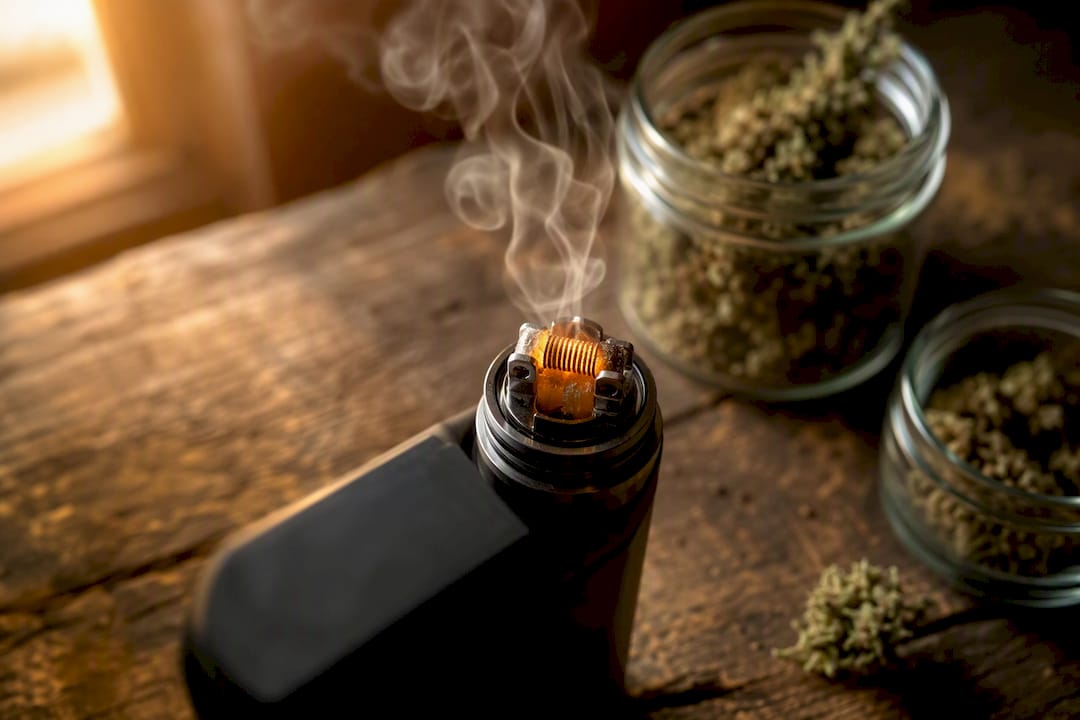
No, recent research does not make it possible to say that CBD vapoter is safe. Studies published between 2023 and 2025 show pulmonary inflammation, oxidative stress and, in some cases, cell mortality of concern in the laboratory. Uncertainty remains high due to a lack of long-term human studies, but the available signals warrant real caution, especially if you regularly inhale CBD-based e-liquids. The following sections detail what these studies show, how to reduce risks and what alternatives exist.
In brief:
- Vapoter of CBD can cause pulmonary inflammation, oxidative stress and cellular damage, even if the exact magnitude of the risk remains to be confirmed.
- Animal and cellular studies show that exposure to CBD aerosols causes greater damage than that of nicotine, including cell death of up to 60%.
- Thermal degradation of CBD during vaporization forms irritant quinones and carbonyls, especially with high power or unadapted oils.
- The presence of additives such as vitamin E oil or contaminants greatly increases the risk to the respiratory tract.
- Pregnant people with respiratory diseases or under specific treatment should avoid vaping CBD due to insufficient safety data.
Table of Contents
- What the safety studies of the vapoted CBD say
- How vaping CBD can damage your lungs: the mechanisms involved
- Side effects and warning signs to be monitored
- Reduce risk if you choose to vapote CBD
- Sublingual, oral or topical: alternatives to inhalation
- Who should avoid vaping CBD
- Our resources to verify the quality of a CBD product
- What you really need to remember about the vape CBD
- Sources
What the safety studies of the vapoted CBD say
The short answer: the available scientific evidence does not reassure as much as the marketing of the sector would suggest. Since 2019, the research has accumulated data that all point in the same direction, that of a real lung risk, even if its exact magnitude remains debated.
A study conducted by researchers from the Roswell Park Comprehensive Cancer Center compared the lung effects of vaping CBD with those of vaping nicotine in mice. The result surprised some of the scientific community: exposure to CBD aerosols caused more focal lesions and increased activity of myeloperoxidase, an inflammation marker, than exposure to nicotine. In other words, in this animal model, vaposite CBD does not appear as the option « Sweet » We lend him a lot.
One published study on PMC In the case of human bronchial cells in culture, there is additional and more worrying light. The researchers exposed these cells to aerosols containing cannabinoid oil and vitamin E acetate (VEA), an additive sadly associated with the US-derived outbreak of DVALI. As a result, a physical accumulation of oil on the cell surface and a high rate of cell mortality increased significantly after several days of exposure. This figure does not concern living human lungs, but it reveals a documented toxic mechanism under controlled conditions.
These two works are not isolated. One toxicological journal published in 2025 The market for cannabinoid vaping products remains largely unregulated, and many of the samples tested contain contaminants (heavy metals, residual solvents, uninhaled flavours) in addition to generating toxic by-products such as quinones and carbonyls under heat.

The EVALI episode of 2019 and 2020 remains the reference for health alerts related to cannabinoid vaping. Analyses of the cases identified at the time found AEV in a majority of samples taken from hospitalized patients for acute lung injury. The exact mechanism has never been fully elucidated, but the correlation between AEV and severe lung injury has been sufficiently clear to trigger product withdrawals and federal health warnings.
Three findings emerge from this mass of data:
- Cell and animal studies consistently show inflammation and oxidative stress associated with inhalation of cannabinoid aerosols.
- The presence of contaminants such as AEV significantly worsens these effects, but damage is also observed with more « clean ».
- Longitudinal studies on humans continued to be lacking for several years, thus preventing the precise quantification of long-term risk.
One figure to remember: In the cell model tested by the team behind the above-mentioned PMC publication, CBD and VEA combined exposure resulted in up to 60% cell mortality in just a few days, a result that led several toxicologists to demand more compositional testing on marketed products.
This methodological limit counts. Most current data come from cell cultures or animal models, not controlled human clinical trials. This does not mean that the human risk is zero or exaggerated: this means that there is still a lack of regression to establish a reliable dose-effect curve in humans. The World Health Organization's report on CBD also highlights the same grey regulatory area, calling for enhanced monitoring of the composition of products in circulation.
How vaping CBD can damage your lungs: the mechanisms involved
Understanding why vapotate CBD is a problem requires an interest in what actually happens in the resistance of your device at the time of heating. It is not CBD as a molecule that worries researchers the most, but what it becomes once sprayed at high temperature.
When an e-liquid heats up, some of its components degrade chemically. CBD can then be transformed into cannabinoid quinones, reactive molecules capable of generating oxidative stress in lung cells. A recent toxicological review points out that this phenomenon occurs even with extracts considered pure, which means that a product without an apparent contaminant is not automatically safe once heated. The heater also generates carbonyls, a family of airway irritant compounds, already well documented in the context of nicotine vaping.
The choice of carrier oil plays an equally important role. E-liquids designed for inhalation generally use propylene glycol (PG) and plant glycerine (VG), two solvents tested and validated for this method of administration. The problem arises when manufacturers use oils not designed to be sprayed, such as MCT oil or coconut oil, often used in CBD sublingual oils. These oils do not vaporize properly: they tend to settle as fine droplets in the respiratory tract rather than completely evaporate.

This is exactly what the above-mentioned cellular study shows: the accumulation of oil observed on exposed bronchial cells reflects this lipid deposition phenomenon. Once this oily film is installed on the respiratory epithelium, it can disrupt mucociliary clearance, a natural mechanism by which your lungs evacuate particles and pathogens through the movement of vibratile eyelashes. A lung with impaired clearance becomes more vulnerable to infections and takes longer to regenerate after an attack.
The heating temperature amplifies or mitigates all these phenomena. Work on the thermal degradation of e-liquids show that excessive power increases the formation of carbonyls and other degradation products. The stronger your device heats, the more toxic by-products it generates, regardless of the initial quality of the liquid used.
- Cannabinoid quinones are formed by heat, even from pure extracts.
- MCT and coconut oils, not designed for inhalation, promote lipid deposition in the lungs.
- High heating power mechanically increases the production of irritant carbonyls.
- The accumulation of oil disturbs mucociliary clearance, the natural self-cleaning system of the respiratory tract.
A softer heater limits the thermal degradation and prolongs the life of your resistance, which crashes faster with the CBD than with a classic e-liquid.*
Side effects and warning signs to be monitored
Beyond the long-term lung risk, vapoting CBD can cause immediate effects, most benign but sometimes revealing a more serious problem. Here's how to distinguish them.
- Somnolence and dry mouth. These are the most frequently reported effects with CBD, regardless of its form of consumption. They often appear within one hour of inhalation and generally remain light.
- Throat irritation and mild cough. Frequent in beginners or when switching to more powerful resistance, it usually disappears by adjusting the power of the device or by sparing sessions.
- Nausea and changes in appetite. Some users report a decrease in appetite, others the opposite, a sign that the individual response to CBD varies greatly from person to person.
- Dizziness and diarrhoea In the event of a high dose, two effects documented in the clinical records of CBD in all its forms.
- Respiratory distress, persistent cough or shortness of breath. These are the signals that must make you stop immediately and consult a healthcare professional, especially if they appear within days of the use of a new product.
Drug interactions deserve special attention. CBD is metabolised by the CYP3A4 and CYP2C19 enzymes of the liver, the same routes used by many common medicines (anti-magulants, some anti-epileptics, some antidepressants). According to Harvard University's health blog, anyone undergoing treatment metabolised by these enzymes should consult their doctor prior to regular consumption of CBD, including vapota, as inhalation changes the rate of absorption compared to oral intake.
The practical rule remains simple: a light and transient effect does not necessarily justify stopping, but any respiratory discomfort that persists beyond a few days, or that worsens, must lead you to consult without delay. This is not the time to « See if it's happening. ».
Reduce risk if you choose to vapote CBD
If you still decide to vapote, some practical precautions make a real difference to your exposure to problematic substances. They do not remove the risk, but they significantly reduce it.
The first and most important reflex is to require a Certificate of Analysis (COA) for each product purchased. Serious AOCs should confirm the absence of AEVs, indicate the levels of heavy metals and residual solvents, and specify the exact THC and CBD content of the product tested. A seller who is unable to provide this document, or who proposes an expired COA, generic or impossible to connect to a specific lot, must immediately alert you.
The choice of the product counts just as much as its composition. Prefer to e-liquids explicitly formulated for inhalation, based on PG and VG, and avoid any product sold as sublingual oil but reused for vapote. An MCT oil or coconut oil, even of food quality, was never designed to withstand a repeated heat in a vapotous resistance.
Your device settings have a direct impact on the amount of toxic by-products generated. Low power, usually between 7 and 12 watts for conventional PG/VG formulations, limits thermal degradation and thus the formation of carbonyls. Cleaning your equipment regularly avoids the accumulation of residues that burn each new use and release additional compounds.
In terms of use itself, starting with small amounts, spacing sessions in the day and keeping a log of your symptoms allows you to quickly spot an abnormal reaction. This personal monitoring, often overlooked, remains one of the easiest tools to adjust your consumption before a problem arises.
- Always require an updated COA, linked to the specific lot of the purchased product.
- Choose PG/VG e-liquids designed for inhalation, never diverted sublingual oils.
- Set your device to low power and clean it regularly.
- Start with small doses and note your reactions in a follow-up notebook.
- Check the origin of the hemp and the complete traceability of the product before purchase.
Pro Council: Keep a photo or a copy of the COA of each lot you purchase. In case of unusual symptoms, this document allows a healthcare professional to quickly identify whether a specific contaminant could be involved.
Sublingual, oral or topical: alternatives to inhalation
Vapoter is not the only way to access the desired effects with CBD, far from it. Three routes of administration completely avoid lung exposure, each with its own compromise in terms of speed and duration of action.
The way sublingual, in the form of oil deposited under the tongue, offers a good compromise between rapid action (15 to 30 minutes in general) and accurate dosing control thanks to the dropper. This is the closest option to vape in terms of speed, without the risks associated with combustion or vaporization.
The way Oral, via capsules or edibles, requires more patience: the effect often takes 45 minutes to two hours to install, as CBD must first go through digestion. In return, the duration of action is generally longer, which is suitable for use over the day or before bedtime.
The Topical, creams, balms and roll-ons, act locally on the applied area without significantly passing into the bloodstream. They are suitable for localized muscle or joint pain, but do not provide a systemic effect comparable to inhalation or oral use.
- Sublingual : ideal if you are looking for a quick effect with a precise dosage, without the lung risks of vape.
- Oral : suitable for regular and prolonged use, with a longer delay of action to anticipate.
- Topic : relevant for localized discomfort, with no general desired effect.
Who should avoid vaping CBD
Some profiles present an increased risk that justifies simply avoiding vaping, regardless of the quality of the product chosen.
- Pregnant or nursing women, due to the lack of adequate safety data on lung exposure and placental or lactic passage of inhaled compounds.
- People with chronic respiratory diseases (asthma, COPD), for whom any additional airway inflammation poses a disproportionate risk.
- People undergoing treatment metabolised by CYP3A4 or CYP2C19 enzymes, such as some anticoagulants or antiepileptics, which must consult their doctor before regular consumption.
- Minors and adolescents, whose lungs are still developing and particularly sensitive to irritating and inflammatory effects demonstrated by animal research.
What you really need to remember about the vape CBD
Caution on vaping CBD is not an excessive posture, it is an honest reading of the available data. What strikes me most in this scientific literature is the mismatch between the marketing discourse that presents vape as a method « clean » and « Modern », and laboratory results that show comparable or even greater cellular damage to nicotine vaping.
The sector's generic council (« Just check that it's pure CBD ») lacks essential : even an extract without contaminant generates toxic quinones at the heat. The real priority is therefore not only the purity of the product, but the frequency of use and adjustment of your device. If you are looking for relaxation or one-off relief, a sublingual oil avoids this pulmonary compromise without sacrificing anything effective.
— Rod
Sources
- Not all vaping is the same: differential plumonary effects of vaping cannabidiol versus nicotine
- Cannabinoid Vaping Products: Regulation, Composition, Toxicological Effects, and Emerging Research
- Vaping CBD causes more severe lung damage than vaping nicotine (Roswell Park press release)