


Delivery of CBD in France: practical and legal guide
The delivery of CBD products is legal in France, provided that the THC rate does not exceed [0.3%] and that the products come from hemp varieties authorised by the EU](https://www.legifrance.gouv.fr/). Before any shipment or receipt, three actions are required: check the certificate of analysis (COA) of the lot concerned, prepare a neutral and hermetic packaging, and then choose a shipping method with follow-up. Ignoring one of these steps is subject to customs seizure or even administrative penalties.
Key points
A compliant CBD delivery is based on three inseparable pillars: one COA per batch, one hermetic neutral packaging, and one carrier with follow-up.
| Dot | Details |
|---|---|
| THC legal threshold | Any product shipped must have a THC rate of less than 0.3% on its COA. |
| Mandatory COA per batch | The certificate of analysis must correspond to the consignment shipped and be downloadable online. |
| Neutral and hermetic packaging | Aluminized or vacuum bag, without CBD indication visible outside the package. |
| Carrier with tracking | Prefer a traceable shipping mode (24–72 h depending on option) with assurance if necessary. |
Table of Contents
- What are the French rules for sending CBD?
- What CBD products can we actually deliver?
- How to prepare a compliant and discreet CBD package?
- Which carrier chooses for a discreet and reliable delivery?
- What if your CBD package is detained in customs?
- Sending CBD to the UK, Switzerland or the EU: what changes
- How to check that a CBD seller is really reliable?
- Storage, neutralization of odors and classic mistakes to avoid
- What experience teaches about discretion and traceability
- Sources
What are the French rules for sending CBD?
These requirements apply to both sales and shipping, whether you are private or professional.
Traceability is the other pillar of the legal framework. Each batch must be accompanied by an AOC (certificate of analysis) issued by an accredited laboratory, mentioning the cannabinoid concentration, the absence of pesticides and the measured THC level. To deepen the regulatory history, the European CBD context offers useful lighting.
Some prohibitions to keep in mind:
- Medical claims To say that a CBD product cures or treats a disease is prohibited by French regulations on the advertising of health products.
- Novel food not approved : CBD-based food supplements (gels, gummies) must comply with the European Novel Food Regulation; Without approval, their marketing remains risky.
- Exceeded THC A product with 0.31% THC at COA may be sufficient to trigger a seizure.
To verify the current texts, Legifrance and the dedicated pages of the ARS are the official references to be consulted as a matter of priority. A detailed analysis of the French CBD regulations is also available for readers wishing to go further.
What CBD products can we actually deliver?
Not all formats have the same level of logistical or legal risk. Here is a clear reading of the situation:
Formats generally accepted without particular difficulty:
- CBD oils (broad spectrum, full spectrum, CBG, CBN) with COA and THC < 0.3%
- Cosmetics (creams, balms, roll-ons, patches): well framed category, little customs friction
- CBD teas and infusions: treatment similar to aromatic herbs if THC level is consistent
- CBD resins and flowers: allowed if THC remains below the legal threshold and traceability is complete; remain the most scrutinised category during the checks
Formats to be treated with caution:
- Gummies and edibles: subject to the European Novel Food Regulation; their status varies according to the formulation and approval obtained
- E-liquids and vaps: legal if compliant, but the information on the package must be irreproachable
- Any product with therapeutic claims: to be avoided absolutely, whatever the form
On the question of the use of flowers,ARS Occitanie recommends that low-temperature spraying or infusion rather than combustion be preferred to reduce respiratory risks. This is a point to remember both for the choice of the product and for the tips for use to be included in the package.
How to prepare a compliant and discreet CBD package?
Good preparation significantly reduces the risk of seizure or delay. Here are the steps in logical order:
- Gathering Documents COA of the current batch, product data sheet with concentration and batch number, complete labelling (composition, THC rate, origin).
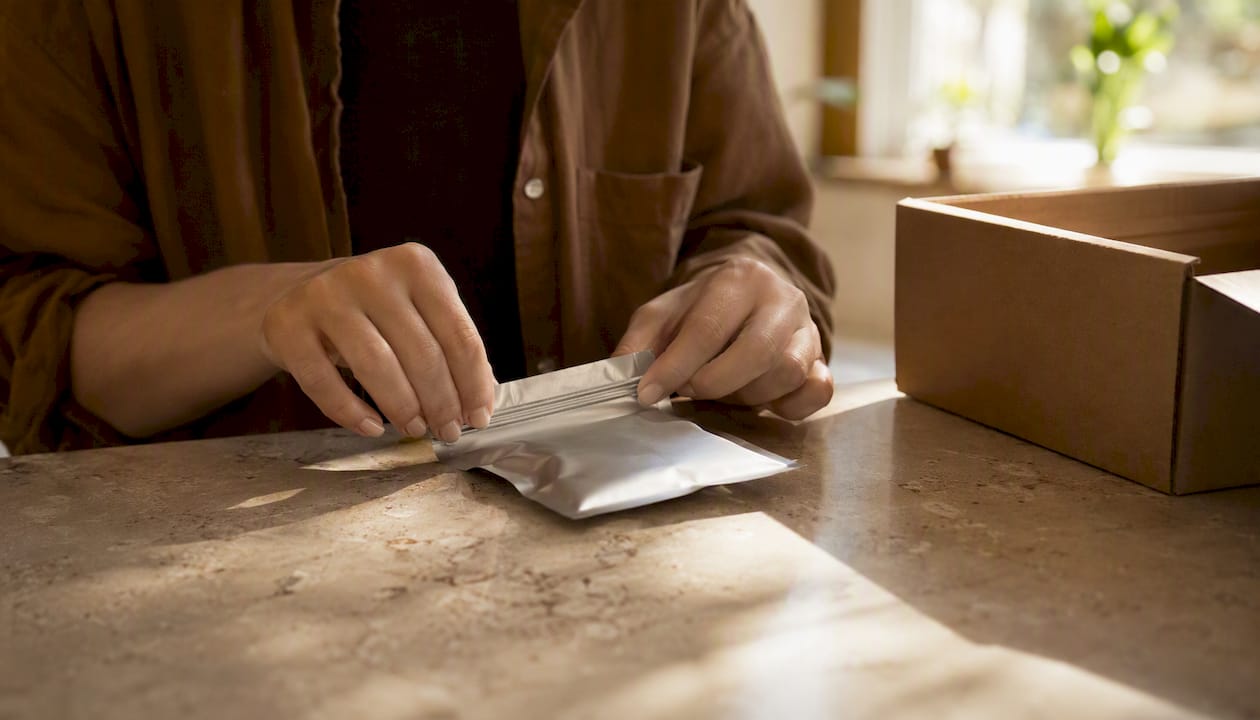
- Choose packaging : neutral box or envelope, without logo or CBD mention visible on the outside. Inside, place the product in an aluminized or vacuum sachet to neutralize odours.
- Seal hermetically : a packaging that lets smells pass attracts attention during the checks; Vacuum sealing remains the most effective method.
- Slide a copy of the COA inside In the event of an inspection, the consignee or carrier may immediately prove the conformity of the product.
- Limit volume per package : shipping reasonable quantities reduces the likelihood of attracting attention. Professionals in the sector generally recommend not to exceed a moderate weight per shipment.
- Choose the right time : shipping early in the week avoids weekend delays and ensures that customer service is reachable if a problem occurs in transit.
Pro Council: Always place a printed copy of the COA inside the package, not only in the shipping slip. If the package is opened during a check, the document is immediately visible and may avoid unnecessary retention.
Deceptive labelling or missing COA remains the leading cause of seizure in the sector. The Safe online CBD command guide details the complete processing procedure until shipment.
Which carrier chooses for a discreet and reliable delivery?
The choice of the carrier directly influences discretion, traceability and litigation management. According to good logistics practices for CBD stores, the most used options in France are Colissimo, Mondial Relay, Chronopost, DPD and Relais Colis.
Some criteria to check before selecting a carrier:
- Policy on hemp products Some carriers contractually exclude cannabis products, even legal ones. Read the Terms and Conditions or request written confirmation.
- Insurance and declared value : for value orders, take out a package insurance cover in case of loss or damage.
- Automatic notifications A carrier that sends SMS or e-mail alerts at each step reduces requests to the customer service and reassures the recipient.
The standard practical times are from 24 to 72 hours according to the chosen mode, with a neutral packaging guaranteed by serious e-commercers. Relay point withdrawal often offers the best combination of discretion/traceability: the recipient recovers the package at its own pace, without signature at home.
What if your CBD package is detained in customs?
A customs check on a CBD package usually follows a predictable pattern.
If your package is selected, the following procedure should be followed:
- Contact the carrier immediately to obtain the retention number and customs office concerned.
- Request a written report specifying the reason for the detention; This document is indispensable for any further action.
- Join seller and transmit the report: a serious seller has the original COA and can send it directly to the competent authorities.
- Prepare the compliance file COA of the lot, purchase invoice, product labelling, proof of origin.
- Contact the local customs office if the retention extends beyond 48 hours without a response.
To limit this risk upstream, complete traceability remains the best shield: a COA downloadable on the seller's site, a lot number visible on the packaging and reasonable volumes per consignment significantly reduce the likelihood of thorough control.
Sending CBD to the UK, Switzerland or the EU: what changes
The European Union shares a common framework on the THC threshold, but each Member State retains nuances in the application. The UK and Switzerland, outside the EU, apply their own rules.
Essential points to check before any international shipment:
- EU The THC threshold of 0.3% applies in most Member States, but some countries (Austria, Slovakia) maintain stricter restrictions on flowers. Check the local legislation of the receiving country.
- Uk Since Brexit, CBD has been regulated by the Food Standards Agency (FSA). CBD-based food products must be included in the Novel Food list validated by the FSA to be legally marketed.
- Switzerland The THC threshold is set at 1%, which is more permissive than in France, but the import and labelling rules remain specific.
- Third countries The situation varies considerably. Some countries still classify all cannabis derivatives as amazing, regardless of THC levels.
How to check that a CBD seller is really reliable?
A serious seller recognizes itself to concrete signals, not marketing promises. Here is what to look for before placing an order:
- COA by batch, downloadable The certificate must be accessible directly on the product page with the lot number corresponding to the item on sale. A generic or multi-year COA is a warning signal.
- Rate of THC explicitly mentioned : the exact value must appear on the product form and in the COA, not only « in accordance with the law ».
- Extraction method indicated Supercritical CO2 extraction ensures better purity and absence of solvent residues. This is a quality criterion that serious sellers put forward.
- Origin of traceable hemp variety, country of cultivation, farmer or cooperative if possible.
- Contactable customer service : a functional e-mail address, a telephone number or a reactive cat. Test it before buying if the order is important.
- Clear return policy The return and refund conditions must be legible, unambiguously on CBD products.
- Full legal information : physical address of the company, SIRET number or European equivalent, responsible for identifiable publication.
Always keep a copy of the COA and your exchanges with the seller. In case of customs dispute or claim, these documents are your main proof. The purchase guide legal CBD details the steps to secure each order.
Storage, neutralization of odors and classic mistakes to avoid
The quality of a CBD product can deteriorate even before shipping if storage conditions are neglected. Terpenes, responsible for aromas and some of the effects, are sensitive to heat, humidity and direct light. Ideal storage is done at a stable room temperature (between 15 and 20 °C), in the shelter of UV light and in an airtight container.
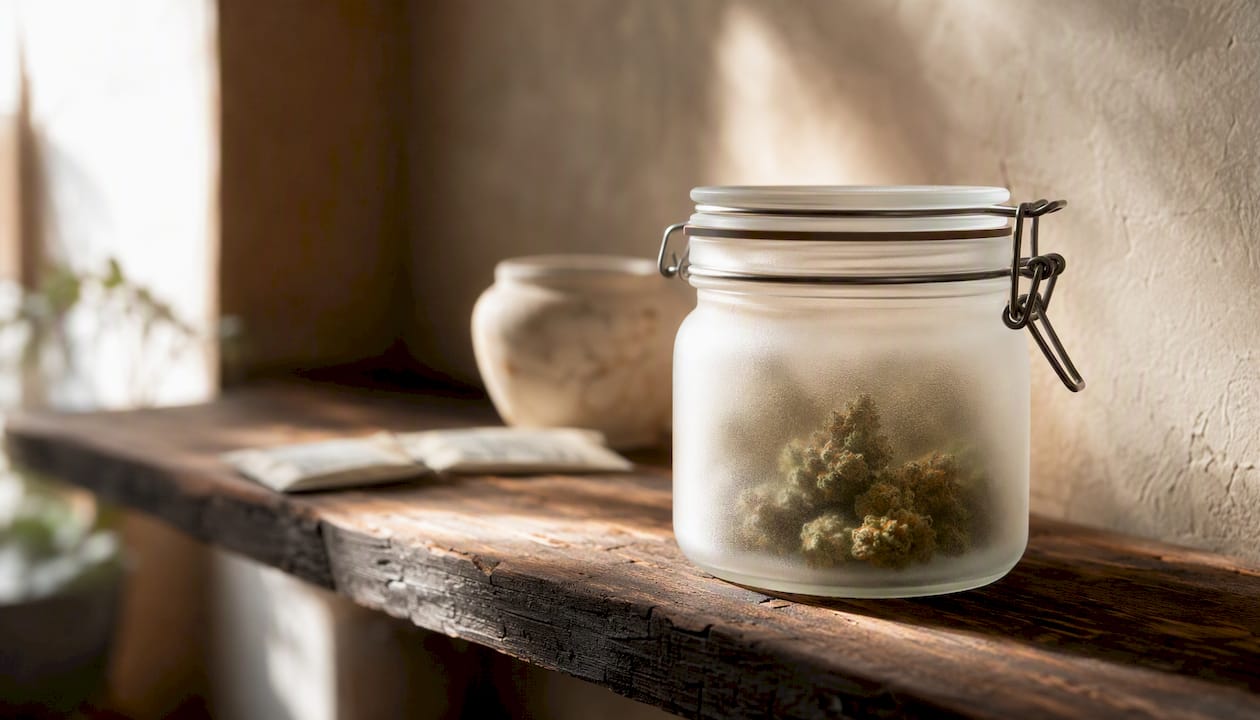
For odour neutralisation, industry professionals systematically use aluminized bags or vacuum packaging. Gel or granulated deodorizers may complement the device, provided they are never placed in direct contact with the product, as some compounds may migrate and alter the composition.
Pro Council: Avoid shipping large packages or repeated orders from the same address over a short period of time. Grouped shipments attract more attention during checks than individual commands spaced.
The most frequent errors observed in the sector:
- External labelling explicitly mentioning « CBD » or « cannabis »
- COA missing or not corresponding to consignment shipped
- Therapeutic claims on the package or package
- Excessive quantities for personal use
What experience teaches about discretion and traceability
The delivery of CBD is one of these topics where theory and practice often diverge. On paper, the rules are clear. In fact, the majority of problems occur not because the product is illegal, but because the documentation is incomplete or the packaging attracts attention.
What strikes, after analyzing dozens of cases of seizures and disputes, is that traceability is not only a legal obligation: it is a practical protection tool. A well presented COA, a visible lot number, a sober packaging — These details make all the difference when checking. The sellers who publish their COA by lot and who specifically answer questions about origin and extraction are not content to comply with the law; They build a lasting relationship of trust with their customers.
For any practical questions on an order or shipment, customer service remains the best resource. A fast and documented response is better than any generic guide.
Sources
For any regulatory or logistical audit, these resources refer to:
- ARS Occitanie — risks associated with the use of cannabidiol (CBD)
- CBD delivery guide France: fast, legal, discreet in 2026 – Directory of CBD stores in France
This article constitutes general information and does not replace the opinion of a qualified physician. Consult a qualified health professional about your personal case before acting on this content.