


CBD: Origins, History and Legislation in France

In brief:
- CBD, a compound with no euphorising effect extracted from cannabis, is legitimized in France with THC below 0.3%. The EU Court of Justice confirmed the legality of CBD produced in the EU in 2020, while only Epidyolex is an authorised medicine for rare epilepsy. Scientific research mainly validates its use for these diseases, but the market remains dominated by welfare products.
Cannabidiol (CBD) is a compound naturally present in Cannabis sativa, without euphoric effect, first isolated in the 1940s by American chemist Roger AdamsThen the structure of which was elucidated in 1963 by Israeli researcher Raphael Mechoulam. In France today, its sale is permitted provided that the THC content remains below 0.3% and that no therapeutic claims are made in accordance with the guidelines of theSickness insurance. Only one CBD-based medicine, Epidyolex, has a supervised pharmaceutical authorisation for specific rare epilepsies. Everything else is about well-being, not medicine.
Some key points before going further:
- Roger Adams isolated CBD in the 1940s from the United States.
- Raphael Mechoulam determined its structure and stereochemistry in 1963 in Israel.
- The Court of Justice of the European Union (ECJ) In 2020, a founding judgment was issued which prevented Member States from prohibiting CBD legally produced in the EU.
- Epidyolex is the only medicine with cannabidiol authorised in France, on prescription, for certain rare epilepsies.
- In France, the legal threshold for THC for non-medical products is set at 0,3 %.
The full chronology and practical implications for French consumers and sellers are detailed in the following sections.
Table of Contents
- What is the chronology of the origins of CBD, from antiquity to today?
- How was the CBD discovered and how is it different from THC?
- How was hemp used across civilizations?
- What is the current CBD regulation in France and Europe?
- What CBD products do we find on the French market and how to choose well?
- What are the risks and limitations of clinical evidence on CBD?
- Who consumes CBD in France and why?
- Key points
- What CBD history reveals about our relationship to plants
- Sources useful for further development
What is the chronology of the origins of CBD, from antiquity to today?
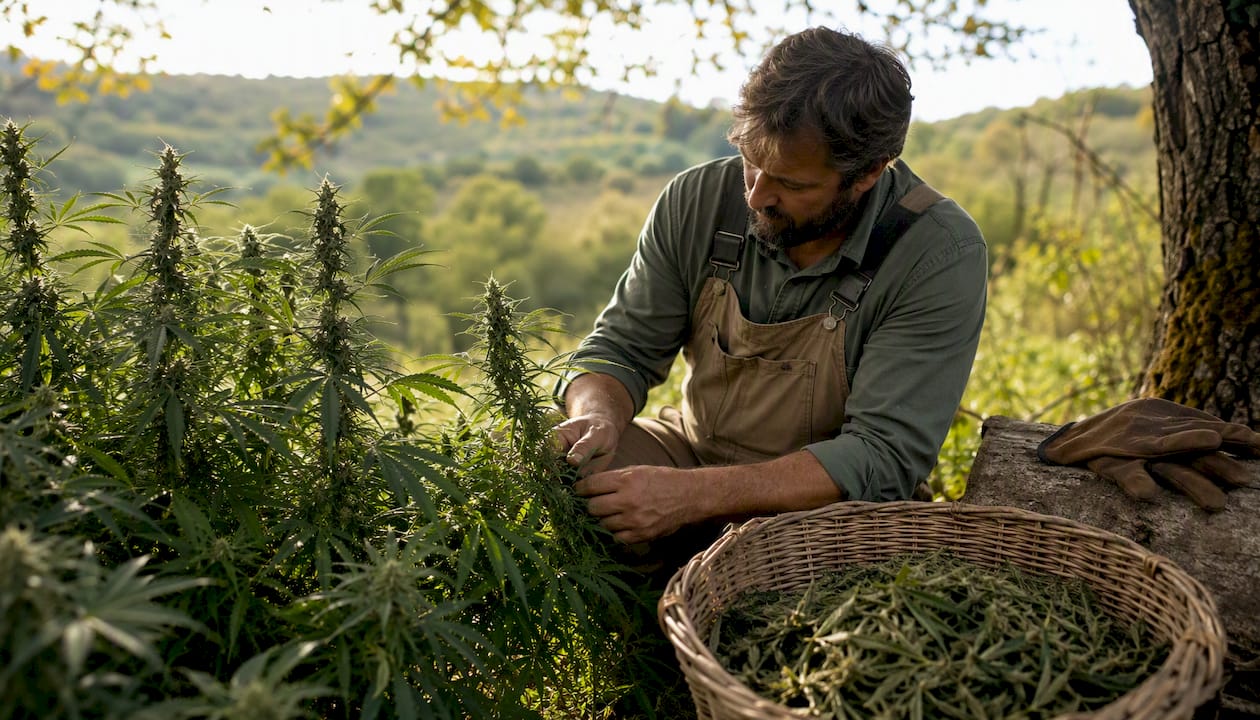
The history of CBD cannot be told without that of hemp, a plant cultivated long before anyone knows what a cannabinoid was. The archaeological research and historical synthesis of IMEP-CNRS place the first domestication of hemp in Asia several thousand years ago, making it one of the oldest cultivated plants known to mankind.
| Benchmark | Location/region | Event | Source |
|---|---|---|---|
| — | Asia (China, Taiwan) | First archaeological traces of hemp cultivation; use of fibres and seeds | IMEP-CNRS |
| — | China | Mention of hemp in the Pen Ts的ao Ching (Pharmacope of Emperor Shennong) for medicinal purposes | ScienceDirect |
| — | India | Use of bhang (cannabis preparation) in Ayurvedic medicine and Vedic rituals | ScienceDirect |
| Antiquity | Egypt, Greece, Rome | Hemp used in the manufacture of ropes, sails and textiles; some documented medicinal uses | IMEP-CNRS |
| Middle Ages | Western Europe | Industrial cultivation of hemp for sea ropes and textiles; marginal medical use | IMEP-CNRS |
| 19th century | Europe, North America | Introduction of cannabis in western pharmacopoeia; dyes and extracts prescribed by doctors | ScienceDirect |
| 1940 | Usa | Roger Adams isolates CBD for the first time from Cannabis sativa | Wikipedia |
| 1963 | Israel | Raphael Mechoulam determines the structure and stereochemistry of CBD | Wikipedia |
| 1990 years | International | Discovery of the endocannabinoid system (CB1 and CB2 receptors); renewed interest in cannabinoid research | ScienceDirect |
| 2020 | European union | Judgment of the CJEU : CBD cannot be assimilated to a narcotic; free movement in the EU under conditions | CJEU |
| 2021–2026 | France | Successive regulatory adjustments: 0.3% THC threshold, status debates novel food, flower frame | Ameli.fr |
Two milestones deserve special attention. The ECJ judgment of 2020 changed the situation for the whole European market: by ruling that CBD produced legally in one Member State could not be banned in another, the Court opened the way for supervised marketing throughout the EU. In France, this resulted in a series of regulatory adjustments, including setting the THC threshold at 0.3% for non-medical products.
The other often underestimated milestone is the discovery of the endocannabinoid system in the 1990s. Without it, the work of Adams and Mechoulam would have remained chemical curiosities. It is precisely the identification of CB1 and CB2 receptors that gave a pharmacological framework to the observed effects and relaunched research on CBD worldwide.
How was the CBD discovered and how is it different from THC?
The discovery of cannabidiol is the result of two distinct scientific stages, often confused. Roger Adams, chemist at the University of Illinois, isolated CBD in the 1940s from Cannabis sativa. But isolating a molecule is not enough to understand how it works: one must know its three-dimensional structure. Raphael Mechoulam, at the Hebrew University of Jerusalem, solved this problem in 1963 by determining the exact structure and stereochemistry of cannabidiol. This confirmation made possible the subsequent serious pharmacological studies.
CBD and THC: same plant, radically different effects
CBD and tetrahydrocannabinol (THC) share the same crude formula (C21H30O2) but differ in spatial arrangement, which explains very distinct biological interactions. THC binds strongly to CB1 receptors of the central nervous system, producing the effect « graying » characteristic of recreational cannabis. CBD, on the other hand, interacts little with these receptors and acts mainly on serotoninrgic receptors, which explains its soothing effects without altered consciousness.
The MSD Manuals specify that CBD may nevertheless have certain psychoactive effects as defined, and that it affects vigilance. In other words, to say that CBD is « Totally not psychoactive » is an inaccurate simplification, even if its effects are not in common with those of THC.
Here are the major scientific discoveries and their implications:
- 1940 (Roger Adams) : first isolation of CBD, opening the way for the study of non-psychotropic cannabinoids.
- 1963 (Raphael Mechoulam) : elucidation of the structure and stereochemistry of CBD, making possible rigorous pharmacological studies.
- 1990 years Identification of CB1 and CB2 receptors and endocannabinoid system, which provided a biological framework for understanding the effects of cannabinoids.
How was hemp used across civilizations?
Hemp has never been a single-use plant. Wherever it was cultivated, human societies exploited several dimensions simultaneously: fibres for textiles, seeds for food, extracts for medicine and, in certain contexts, the whole plant for rituals. This versatility is precisely what makes its history so rich, and why the modern separation between industrial, medical and recreational use is a relatively recent construction.
In China, Pen Ts的ao Ching, attributed to Emperor Shennong and considered one of the oldest known pharmacopoeias, mentions hemp as a remedy for pain and sleep disorders. The fibres were used to make ropes, clothes and paper long before Europe discovered this plant.
In India, bhang, a preparation based on cannabis leaves and flowers mixed with milk or water, occupied a place in Ayurvedic medicine and in some Hindu rituals dedicated to Shiva. The distinction between medicinal and ritual use was porous, both often overlapping in the same practices.
Around the MediterraneanEgypt, Greece and Rome mainly exploited hemp for its fibres. The ropes of Roman ships and sails of Phoenician galleys were often made from hemp, whose resistance to seawater was appreciated. Egyptian papyruses also mention topical medicinal applications.
In the European Middle Ages, hemp cultivation intensified to meet the needs of the expanding maritime fleets. It's an industrial culture, not medicinal. It was only in the 19th century that Western doctors, particularly in Great Britain and France, began prescribing cannabis dyes for pain, spasm and sleep disorders, before the prohibition of the 20th century put an end to these practices for decades.
What is the current CBD regulation in France and Europe?
The legal framework of CBD in France is based on a central criterion: THC content. Any non-medical product containing CBD must have a THC below the applicable regulatory limit, in accordance with the provisions in force and the details of Sickness Insurance. Therapeutic claims are strictly prohibited for products sold outside the pharmaceutical chain.
| Date | Text / decision | Practical impact |
|---|---|---|
| 2020 | Judgment of the Court of Justice (Kanavape case) | The CBD legally produced in the EU cannot be prohibited in another Member State; free movement under conditions |
| 2021 | French decree on CBD flowers | Authorization to sell hemp flowers and leaves under strict conditions (THC < 0.3%) |
| — | Debates new food (EFSA/European Commission) | The extracted CBD is subject to regulation novel food for food; current authorisation procedures |
| In force | Public Health Code (France) | Prohibited medical claims for non-pharmaceutical CBD products |
| In force | Epidyolex (marketing authorisation) | Only CBD-based medicine authorised in France, on prescription, for specific rare epilepsies |
The distinction between Epidyolex and wellness products is fundamental. Epidyolex is a pure cannabidiol drug prescribed by a neurologist for rare epileptic syndromes such as Draves syndrome. Its dosage, manufacture and medical monitoring are supervised by the National Medicines Safety Agency (ANSM). A CBD product sold in-store or online has nothing to do with this frame: it cannot claim the same effects or guarantees.
Practical checklist for sellers and consumers in France :
- Require Certificate of Analysis (COA) issued by an independent laboratory confirming THC < 0.3%.
- Checklabelling No therapeutic mention, no promise of healing or treatment.
- For food products (gummies, infusions, ingested oils): ensure compliance with the status novel food Europe, which is still being clarified.
- For e-liquids and vaps: comply with specific regulations on vaping products.
- As a consumer: do not drive after consumption of CBD, as effects on vigilance are possible.
- Consult a doctor before regular use, especially when taking medicines.
What CBD products do we find on the French market and how to choose well?
The French CBD market has diversified considerably since the lifting of the flower restrictions in 2021. Today, consumers can find oils (broad spectrum and full spectrum), flowers, resins, capsules, gummies, infusions, cosmetics (creams, balms, patches), e-liquids and even food products such as chewing gums or chocolates. Quality and transparency have become purchasing criteria as important as price.
The distinction between Broad spectrum and full spectrum is worth clarifying. A full spectrum extract retains all cannabinoids, terpenes and flavonoids present in the plant, including traces of THC (under the legal threshold). A broad spectrum extract follows the same principle but with the THC removed. CBD isolate contains only pure cannabidiol. Each profile meets different expectations, and none is universally superior.
What the report of theINRS on the CBD identifies among the reasons used in France:
- Managing stress and anxiety on a daily basis.
- Improved sleep quality.
- Relieving chronic or muscle pain.
- Substitution to other substances (tobacco, recreational cannabis, certain medicines).
- Seeking general well-being without perceived side effects as important.
Checklist to choose a quality CBD product:
- COA (certificate of analysis) : mandatory document, issued by a third party laboratory, confirming the exact composition and absence of contaminants.
- Origin of hemp : to favour European producers subject to EU agricultural regulations.
- Extraction method Supercritical CO2 extraction is the reference for purity; chemical solvent extractions should be avoided.
- Cannabinoid and terpenes profile A complete COA not only details CBD and THC, but also the other minor cannabinoids (CBG, CBN) and terpenes present.
- THC compliance < 0.3% : check systematically on the COA, not only on the label.
What are the risks and limitations of clinical evidence on CBD?
Clinical evidence of CBD is promising in some areas, but remains limited for the vast majority of common uses. Only CBD-based drugs such as Epidyolex have sufficient clinical validation to obtain a marketing authorisation, and only for specific indications: rare epilepsies refractory to conventional treatments. For other uses (anxiety, sleep, chronic pain), the MSD Manuals point out that the results are encouraging but that rigorous clinical studies are still lacking.
The most commonly reported adverse reactions include drowsiness, fatigue, digestive disorders and changes in appetite. Most of the concern is drug interactions: CBD is metabolised by cytochrome P450 enzymes in the liver, the same enzymes that treat many common drugs (anticoagulants, antiepileptics, immunosuppressants). Regular consumption of CBD may therefore affect the efficacy or plasma concentration of these treatments.
The INRS report also recommends special vigilance in the workplace, particularly for occupations requiring sustained attention or driving. The effects of CBD on vigilance, although less marked than THC, are real and documented.
Pro Council: Before regular use of CBD, check with a doctor or pharmacist for potential interactions with your current treatments. Start with low doses, gradually increase, and only buy products accompanied by a complete COA from an independent laboratory.
This article provides general information and does not constitute a medical opinion. For any decision to use or purchase, consult a health care professional and check the official documents in force.
Who consumes CBD in France and why?
The profile of the French consumer of CBD has evolved. According to the INRS report, the motivations for use are mainly related to well-being: stress management, improved sleep and relief of chronic pain are the leading reasons. The substitution of other substances, whether tobacco, recreational cannabis or certain anxiolytic drugs, is also a significant reason.
Note on methodology: French data on the use of CBD are mainly derived from declaratory surveys and observational studies. They reflect the motivations reported by consumers, not clinically validated effects. This distinction is important to correctly interpret these figures.
The INRS report also identifies an increasing concern of employers and occupational physicians about the dissemination of CBD to the workplace, in particular due to the possible effects on vigilance and difficulties in distinguishing CBD and THC in certain screening tests. This is often ignored in commercial communications, but it deserves to be known to consumers.
Key points
CBD is a compound of hemp isolated in the 20th century, whose sale in France is legal under strict conditions (THC < 0.3%, without therapeutic claim), and whose validated medical uses remain limited to a few specific pharmaceutical indications.
| Dot | Details |
|---|---|
| Historical origins | Hemp has been cultivated for several millennia in Asia; The CBD was isolated by Roger Adams in the 1940s. |
| Legal threshold in France | Any non-medical CBD product must contain less than 0.3% THC for legal sale. |
| ECJ judgment 2020 | The EU Court of Justice prohibited Member States from prohibiting CBD legally produced in the Union. |
| Medicinal product vs. welfare | Lepidyolex is the only CBD-based medicine authorised in France; consumer products cannot claim its effects. |
| Limited clinical evidence | Without rare epilepsies, rigorous clinical studies of CBD remain insufficient to validate most common uses. |
What CBD history reveals about our relationship to plants
The history of CBD is, basically, the story of a plant that humanity used for millennia without ever really understanding why it worked. Chinese, Indian and Mediterranean civilizations did not need to know the CB1 receptors to see the effects of hemp on pain or anxiety. They watched, they transmitted, they adapted.
What strikes me in this trajectory is the discontinuity of the twentieth century. Prohibition has interrupted centuries of empirical and medical research, and we have taken decades to catch up with this delay. Mechoulam's work in the 1960s revived a scientific curiosity that could never have extinguished if the political context had been different.
Today, the reverse risk exists: commercial enthusiasm for CBD often exceeds what science actually validates. The evidence is promising for some uses, solid for some (rare epilepsies), and still insufficient for many others. Recognizing this nuance is precisely what distinguishes a serious approach to CBD from a simple marketing argument.
Sources useful for further development
These resources served as the basis for this article. They enable us to verify the information presented and to deepen the legal, scientific or practical aspects according to your needs.
- Ameli.fr — Non-medical CBD: definition and precautions : Official reference of the Sickness Insurance on the legal status, precautions for use and limits of the non-medical CBD in France.
- MSD Manuals — Cannabidiol (CBD) : general medical synthesis of the pharmacology of CBD, its validated indications and its adverse effects.
- INRS — Cannabidiol: state of the art Technical report on reasons for use, occupational risks and prevention recommendations.
- Wikipedia — Cannabidiol : encyclopedic synthesis on the history of CBD isolation, the work of Adams and Mechoulam, and the chemistry of the molecule.
- IMEP-CNRS — Tracing the Hemp Path through History Research article on the archaeological and neolithic origins of hemp cultivation in Asia.
- ScienceDirect — History of medical cannabis : academic article tracing the medical history of cannabis from the origins to the contemporary era.
For any purchase or use decisions, consult the official texts (Public Health Code, ANSM, ANSES) and, in case of medical doubt, a qualified health professional.