


CBD and osteoarthritis: mechanisms and status of evidence

CBD can reduce local inflammation and modulate pain perception through the endocannabinoid system and several other molecular targets, but it does not cure osteoarthritis and human clinical evidence to date remains limited and heterogeneous.
The research observes:
- Pain reduction moderate to moderate analgesic effects appear in some studies, especially preclinical ones.
- Decreased inflammatory markers - decrease in pro-inflammatory cytokines (TNF-α, IL-1β, IL-6) documented in animal models.
- Improved sleep and mobility - reported by some patients in observational studies but not confirmed by large-scale randomized trials.
- Significant variability depending on the form (topic or oral), the dose and quality of the product used.
Prior to integrating CBD into an existing treatment, medical consultation is required, particularly due to possible interactions with certain drugs.
Table of Contents
- What biological target for CBD?
- What is CBD and how does it differ from THC?
- How does CBD affect osteoarthritis? Biological pathways explained
- What preclinical studies of CBD and osteoarthritis show
- Clinical evidence in humans: what do studies really say?
- Topical or oral: Which form to choose for osteoarthritis?
- Safety, interactions and product quality: what to check before buying
- Critical Reading: How to Assess Evidence on CBD and Osteoarthritis
- Key points
- CBD for osteoarthritis deserves attention, not blind enthusiasm
- Useful sources to go further
What biological target for CBD?
The osteoarthritis is a degenerative joint disease, characterized by the progressive destruction of cartilage, the remodeling of subchondral los and secondary local inflammation of the synovial tissue. It's not a simple one. « wear and tear » mechanical: Inflammatory mediators play an active role in the degradation of cartilage and in the sensitization of joint nerve endings.
The pro-inflammatory cytokines, including the interleukin-1β (IL-1β) and the tumour necrosis factor alpha (TNF-α), amplify tissue destruction and activate peripheral nociceptors, which explains the persistent pain even at rest in advanced stages. The inflamed synovial tissue also releases prostaglandins and other mediators that maintain the vicious circle pain-inflammation.
For those affected, this results in mechanical stress pain, morning stiffness, progressive limitation of mobility and, often, impaired sleep. Arthritis of the knee, hip and hands is particularly common after 50 years. Targeting both local inflammation and pain transmission is therefore a coherent therapeutic strategy, and this is precisely where CBD is of biological interest.
What is CBD and how does it differ from THC?
Cannabidiol (CBD) is a phytocannabinoid extracted from Cannabis sativa, mainly hemp varieties with low Δ9-tetrahydrocannabinol (THC). Unlike THC, CBD does not bind directly to brain CB1 receptors with high affinity and therefore does not produce any psychoactive effects, which fundamentally distinguishes it from pharmacologically.
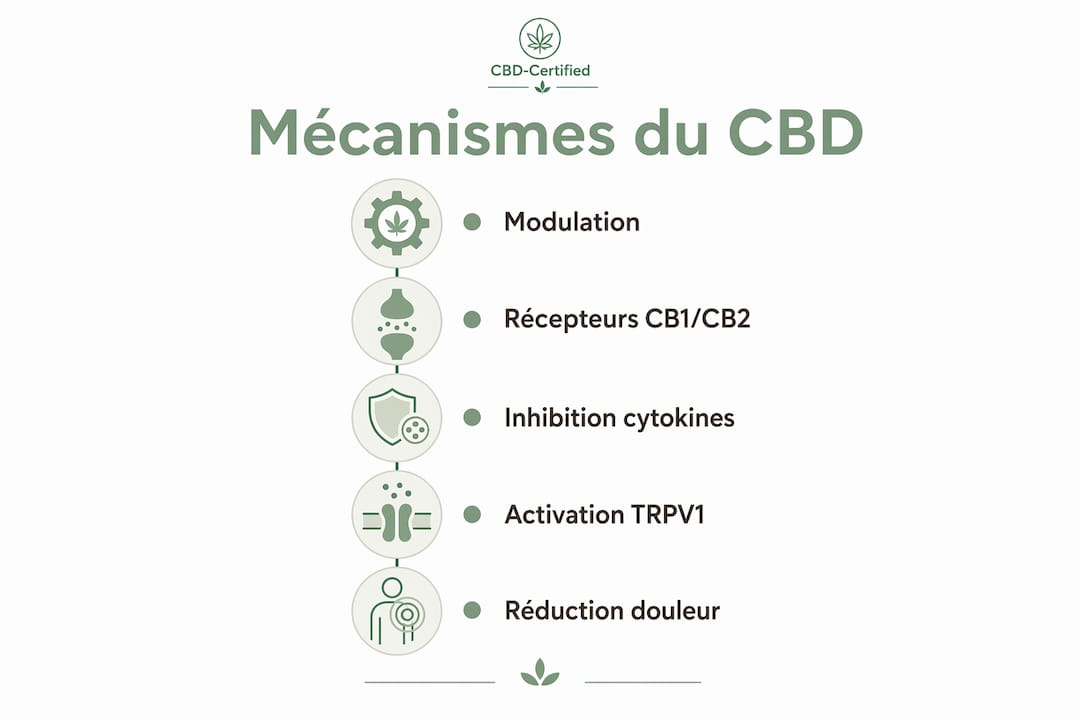
On a mechanistic level, CBD acts indirectly on the endocannabinoid system and modulates several other targets:
- Inhibition of FAAH (fatty acid amide hydrolase), the enzyme that degrades the anandamide, thus increasing local endocannabinoid levels.
- Modulation of TRPV1 channels (vanilloid receptor), involved in the transmission of heat and pain.
- Interaction with PPARγ receptors, which regulate the expression of inflammatory genes.
- 5-HT1A receptor activity (serotonin), contributing to anxiolytic and potentially analgesic effects.
In terms of formulations, three broad categories structure the market:
| Type | Composition | Practical implication |
|---|---|---|
| Isolate | Pure CBD | No other cannabinoids; absent entourage effect |
| Broad spectrum | CBD + other cannabinoids, without THC | Potential entourage effect without THC exposure |
| Full spectrum | CBD + cannabinoids + THC traces | Maximum surrounding effect; THC present (tracks) |
L« surrounding effect » refers to the potential synergy between cannabinoids, terpenes and flavonoids: several studies suggest that a broad or full spectrum extract can be more effective than an equivalent dose isolate, although direct evidence of osteoarthritis remains to be consolidated.
How does CBD affect osteoarthritis? Biological pathways explained
This is the central question for understanding the mechanism of CBD action in osteoarthritis. Several molecular pathways converge to explain the observed anti-inflammatory and analgesic effects.

| Route of action | Molecular target | Expected effect on osteoarthritis |
|---|---|---|
| Endocannabinoid system | CB1 / CB2 receivers | Modulation of inflammation and joint pain |
| Enzymatic inhibition | FAAH → ↑ anandamide | Increased anti-nociceptive endocannabinoids |
| Vanillaid use | TRPV1 channel | Desensitization of peripheral nociceptors |
| Inflammatory use | TNF-α, IL-1β, IL-6 | Reduction of pro-inflammatory cytokines |
| Nuclear route | PPAR Φ | Transcription regulation of inflammatory genes |
The role of CB1 and CB2 receptors deserves special attention. CB2 receptors are strongly expressed in immune cells and peripheral tissues, including synovial tissue. Their activation reduces the migration of inflammatory cells to the joint and reduces the release of cytokines. CBD does not bind directly to CB2 with high affinity, but indirectly modulates this signaling by increasing endogenous endocannabinoid levels.
Modulation of the TRPV1 channel is another key mechanism. This channel, present on peripheral nociceptive nerve fibers, is activated by heat, acids and some inflammatory mediators. CBD acts first as a partial agonist of TRPV1, causing progressive desensitization of the receptor, reducing the transmission of the painful signal to the spinal cord and brain.
Finally, the reduction of pro-inflammatory cytokines is a direct link to the relief of arthrosic pain. Preclinical studies document a decreased inflammatory markers After administration of CBD, including a decrease in IL-1β and TNF-α in the synovial tissue of animal models of arthrosis.
What preclinical studies of CBD and osteoarthritis show
Preclinical data are now the strongest basis for understanding the effects of CBD in osteoarthritis. The results are broadly consistent, although their translation to humans remains conditional.
- Reduction of inflammatory markers Several animal model studies report a significant decrease in pro-inflammatory cytokines (IL-1β, TNF-α) in synovial tissue after CBD administration, both locally and systemicly.
- Improved pain scores Induced osteoarthritis models in rats showed a reduction in painful behaviour (mechanical allodynia, hyperalgesia) after CBD treatment.
- Protective effect on cartilage Some studies suggest that cartilaginous degradation may be slowed in in vitro models via matrix metalloprotease modulation.
- Promising topical use The formulations applied locally show a high concentration in joint tissues with reduced systemic exposure, which is relevant to limiting adverse reactions.
Limits to keep in mind. Animal models of osteoarthritis (often induced chemically or surgically) do not accurately reproduce the complexity of human disease. Preclinical doses are often much higher than those tested in humans, and routes of administration vary considerably from study to study. A reduction in cytokines measured in rats does not automatically translate into clinical relief in an arthrosic patient, as the biology of chronic human pain incorporates psychological, social and neural dimensions that animal models do not capture.
Pro Council: When reading a preclinical study of CBD and osteoarthritis, systematically check the route of administration, the dose in mg/kg and the animal model used. These three parameters determine the relevance of translation to humans.
Clinical evidence in humans: what do studies really say?
The clinical picture is more nuanced than preclinical data suggest. Human tests exist, but their methodological quality varies and their numbers remain modest.

| Parameter | Observation in available studies |
|---|---|
| Number of randomized trials controlled | Few, often small |
| Monitoring period | Usually short (4–12 weeks) |
| Main endpoints | Pain (EVA), sleep quality, joint function |
| Pain results | Moderate to moderate effects in some studies |
| Sleep outcomes | More consistent positive signal |
| Straightness of preparations | Strong (dose, spectrum, route of administration) |
Observational and clinical studies report subjective improvement in pain and sleep in some patients using CBD for chronic joint pain. These results are encouraging, but they suffer from an obvious selection bias: those who report their experience are often those who have perceived a benefit.
To be noted on the level of evidence: institutional resources for health professionals stress the need for robust human testing before any formal recommendation. The current level of evidence does not allow for the inclusion of CBD in official rheumatology recommendations, but it justifies its supervised complementary use under medical supervision.
The main methodological limitations of the available clinical studies are small sample sizes, short follow-ups, heterogeneity of preparations used (dose, spectrum, route) and risk of publication bias. Larger randomized clinical trials with standardized formulations and follow-up durations of at least six months are required to establish solid recommendations.
Topical or oral: Which form to choose for osteoarthritis?
The choice of form of administration is not insignificant. It conditions bioavailability, local concentration in the joint, and adverse reaction profile.
- Topical application (creams, balms, patches, roll-ons) : CBD concentration directly affects subcutaneous and periarticular tissues, with very low systemic exposure. This is the preferred option for localised relief, especially for superficial joints such as fingers, knees or wrists. The action time is fast (15–45 minutes), but the effect time remains short.
- Oral administration (oils, capsules, gummies) Bioavailability is more variable (estimated between 6% and 19% for conventional oral forms, depending on formulation and use with fatty foods). The systemic effect allows to act on several joints simultaneously and can help improve sleep and reduce anxiety associated with chronic pain.
- Sublingual oils The sublingual route offers faster absorption than the capsules, with partial passage through the oral mucosa before digestion.
The ranges of doses reported in human literature vary considerably according to studies and indications. No standard dose is established for osteoarthritis. The conservative rule is to start at low dose and gradually increase by assessing tolerance, always under medical supervision.
Pro Council: For knee or hand osteoarthritis, a combined approach can be considered: a topical application of CBD for immediate and localized relief, complemented by a Broad Spectrom oil taken in the evening for systemic effect and sleep improvement. This strategy should be discussed with a doctor or pharmacist, especially in the case of concomitant drug treatment.
Safety, interactions and product quality: what to check before buying
The safety profile of CBD is generally favourable to doses used in common practice. The most frequently reported adverse reactions are fatigue, digestive disorders (diarrhea, nausea), changes in appetite and, more rarely, elevated liver enzymes at high doses. These effects are most often reversible when the dose is stopped or reduced.
The most documented drug interaction concerns inhibition of cytochrome P450, including CYP3A4 and CYP2C9 isoenzymes. CBD can slow the metabolism of some drugs, including oral anticoagulants (warfarin, apixaban), some antidepressants, and antiepileptics. For anyone undergoing chronic treatment, medical or pharmaceutical consultation is essential before introducing CBD.
On product quality, three criteria are non-negotiable:
- Certificate of Analysis (COA) issued by an independent third-party laboratory, attesting to the actual level of CBD, the absence or quantification of THC, and the absence of contaminants (pesticides, heavy metals, residual solvents).
- Traceability of raw material : origin of hemp, extraction method (preferably supercritical CO2).
- Clear and reproducible strength on the label, expressed in milligrams per dose and vial.
In France, hemp products containing CBD are legally marketed under certain conditions, in particular as regards THC content. Regulation is changing; for any questions about the legal status of a specific product, refer to the National Drug Safety Agency (ANSM) or consult a healthcare professional. CBD is not a medicine and cannot be presented as such.
Critical Reading: How to Assess Evidence on CBD and Osteoarthritis
Here is an honest assessment of the state of knowledge, as an informed reader should read it.
What is solid: Preclinical mechanisms are well documented. Modulation of the endocannabinoid system, inhibition of pro-inflammatory cytokines and desensitization of nociceptors via TRPV1 are biologically plausible pathways supported by PubMed indexed studies. Animal model results are consistent between laboratories.
What is missing: randomised clinical trials on human osteoarthritis are few, short and heterogeneous. The lack of standardization of formulations (dose, spectrum, route) makes comparisons between studies difficult. Long-term functional endpoints (mobility, quality of life over 12 months) are rarely measured.
To evaluate a clinical trial or CBD product, the following questions should be asked:
- Is the study randomized and controlled against placebo?
- Is the formulation accurately described (mg dose, spectrum, route)?
- Is the follow-up long enough (at least 12 weeks)?
- Does the product have a recent COA from an independent laboratory?
- Is the dosage clearly indicated per unit dose?
This article is general information and does not constitute a medical opinion. Consult a healthcare professional for any therapeutic decisions.
Key points
CBD acts on several biological pathways relevant to osteoarthritis, with solid preclinical evidence and insufficient human clinical evidence for formal recommendations.
| Dot | Details |
|---|---|
| Possible mechanisms | CBD modulates the endocannabinoid system, inhibits inflammatory cytokines and desensitizes nociceptors via TRPV1. |
| Preclinical evidence | Animal models show consistent reduction of inflammatory markers and pain scores. |
| Limited clinical evidence | Human tests are few, short and heterogeneous; no official rheumatology recommendations to date. |
| Form and dose | The topical pathway targets the joint locally; the oral route acts systemicly. No standard dose established for osteoarthritis. |
CBD for osteoarthritis deserves attention, not blind enthusiasm
Biology is convincing. The mechanisms by which CBD can interfere with joint inflammation and pain transmission are real, documented and biologically consistent. It's not speculation.
But there is a gap between « plausible mechanism » and « validated treatment », and this gap is precisely where many CBD content loses honesty. Preclinical studies are encouraging, but they do not replace large-scale randomized clinical trials. For osteoarthritis specifically, these tests are still lacking. What research shows today justifies interest, not certainty.
What seems to me the most underestimated in the public debate on CBD and osteoarthritis is the importance of the formulation. A cheap COA-free isolate does not have the same profile as a laboratory-tested Broad Spectrom oil. The quality of the product directly determines the relevance of the experience, and therefore choosing a traceable and documented product is not a commercial detail, it is a basic condition for an honest assessment of the effect.
Useful sources to go further
These resources are used to verify the studies cited and to deepen the mechanisms mentioned in this article.
Indexed scientific studies (PubMed / PMC)
- Hammell et al. (2016) — Topical CBD and osteoarthritis in rats: a preclinical baseline study of local application of CBD in an induced arthritis model.
- Philpott et al. (2017) — CBD and arthrosic pain: Review of anti-inflammatory and analgesic effects in animal models, with discussion on clinical translation.
- Russo (2008) — Cannabinoids and pain: synthesis on the mechanisms of cannabinoid action in the management of chronic pain.
- Pertwee (2006) — Cannabinoid receptor pharmacology: fundamental reference on CB1, CB2 and their endogenous ligands.
- Mechoulam & Parker (2013) — Endocannabinoid system and pathologies Review on the role of the SEC in inflammatory diseases and pain.
Institutional resources
- Health Canada — Cannabis and Cannabinoids for Health Professionals: a reference guide on the pharmacology, safety and drug interactions of cannabinoids.
- ANSM (National Drug Safety Agency) : for regulatory information applicable in France on cannabinoid products.