


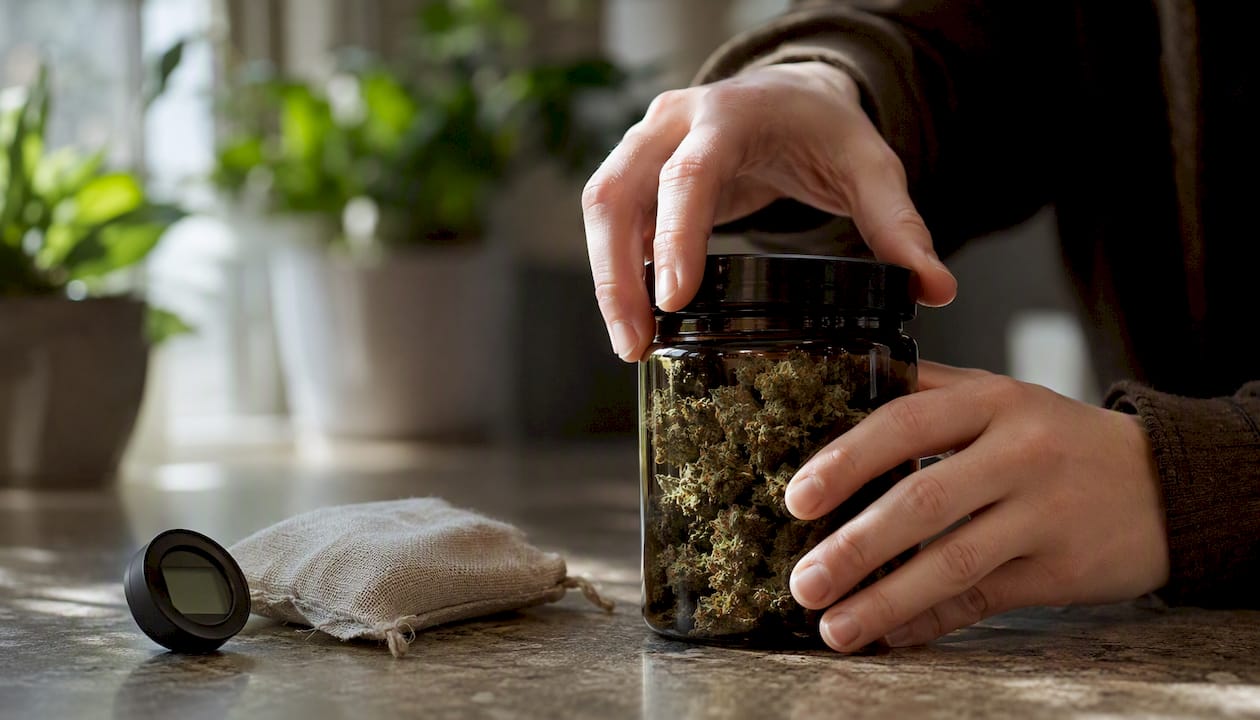
Protect your CBD from light, heat and air: these are the three fundamental rules that determine whether your flowers, oils and cosmetics will retain their aroma and power for months. These silent enemies degrade cannabinoids and terpenes well before the expiry date indicated on the package. A few gestures are enough to avoid this waste.
Immediate actions to be implemented today:
- Transfer your flowers into a sealed glass jar, sheltered from any light source.
- Store all your CBD products in a temperate closet away from radiators and windows.
- Always close each container after use, even for quick use.
- Avoid the bathroom: variable heat and humidity accelerate the deterioration.
- Discard immediately any product with white spots or rancid smell. Never consume a suspicious product.
Table of Contents
- Why conservation changes everything for your CBD
- Specific rules by type of product
- Which containers and accessories choose for optimal storage?
- How to identify that a CBD product has deteriorated?
- Sources, expertise and regulatory framework
- Key points
- What is often learned too late about CBD conservation
- Useful sources and resources
Why conservation changes everything for your CBD
CBD, like all cannabinoids, is a sensitive molecule. Under the effect of ultraviolet light, it degrades by an oxidation process that gradually alters its chemical structure. Terpenes, responsible for the characteristic aromas of each variety, are even more fragile: they evaporate at relatively low temperatures and lose their olfactory complexity in a few weeks if the product is poorly stored.
One published study on ScienceDirect confirms that heat and oxygen significantly increase cannabinoid losses over time. In concrete terms, oil left open on a sunny worktop can lose a significant part of its active ingredients in a few days. For flowers, the risk also extends to moulds as soon as moisture exceeds a certain threshold. Light and heat accelerate this degradation in a measurable manner, which explains why CBD best practices all converge towards the same basic principles.
A stable temperature between 15 °C and 25 °C is the ideal range for the vast majority of products. Below, condensation can damage the flowers; above, the oxidation accelerates.
Specific rules by type of product
CBD storage conditions are not universal: each product form has its own requirements.
E-liquids and vaps
The e-liquids contain aromas and bases that rapidly degrade under the effect of UV and heat. Protect vials from UV and heat sources prevents oxidation and preserves aromas. Prefer opaque bottles, stored in a closed drawer or closet.
Cosmetics, gummy and infusions
These products follow rules similar to classic cosmetics: close after use, avoid hot and wet parts, scrupulously observe the expiry date. CBD gummies and candy are particularly sensitive to heat, which can melt them and alter their dosage. The infusions are preserved like any herbal tea: in a damp shelter, in a sealed box.
Prerolls
Pre-rolls share the same constraints as flowers. A sealed tube or small tinted glass jar protects its shape and moisture. Avoid leaving them in a pocket or bag where they may fry and dry.
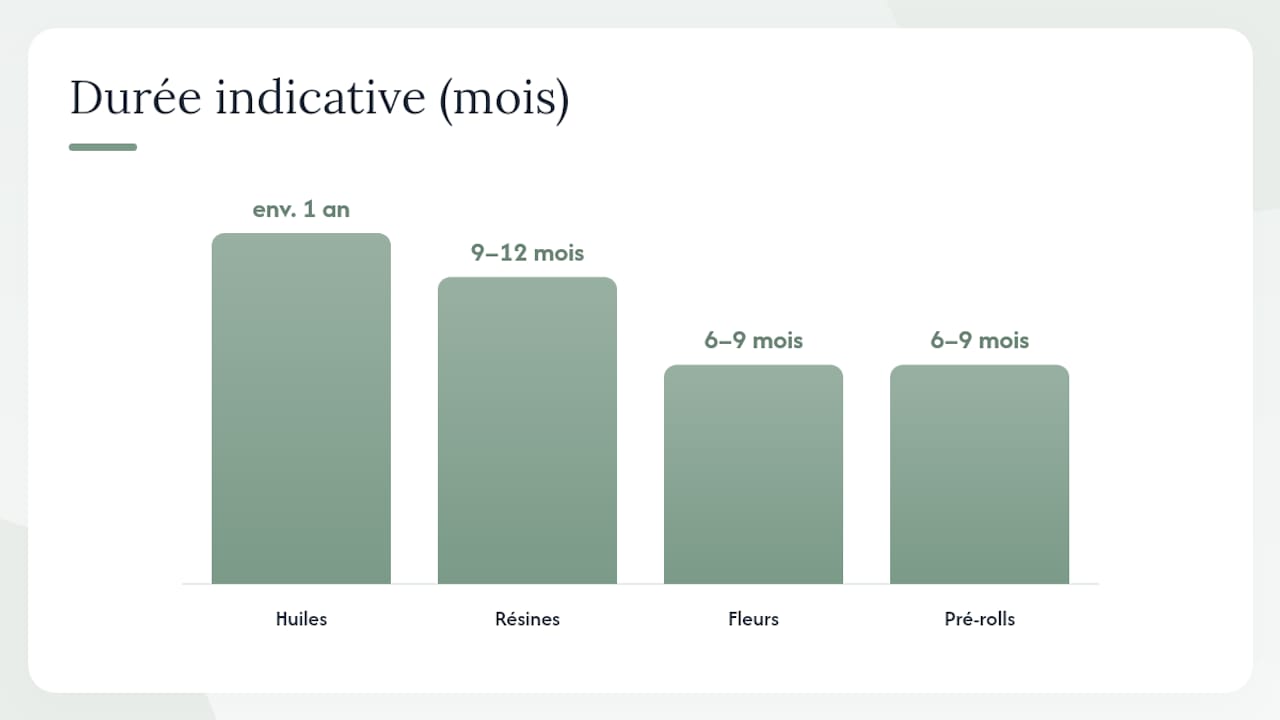
| Product | Target humidity | Temperature | Indicative duration |
|---|---|---|---|
| Flowers | 55–62 % | 15–25 °C | 6–9 months |
| Resin | temperate beach | 15–25 °C | 9–12 months |
| Oils | non-critical | 15–25 °C | Approx. 1 year |
| E-liquids | Not critical | < 25 °C | According to manufacturer |
| Cosmetics/Gummies | Not critical | < 25 °C | On label |
| Prerolls | 55–62 % | 15–25 °C | 6–9 months |
Which containers and accessories choose for optimal storage?
The choice of container is as important as the location. Here are the most common options and what they really bring.
| Solution | Benefits | Disadvantages |
|---|---|---|
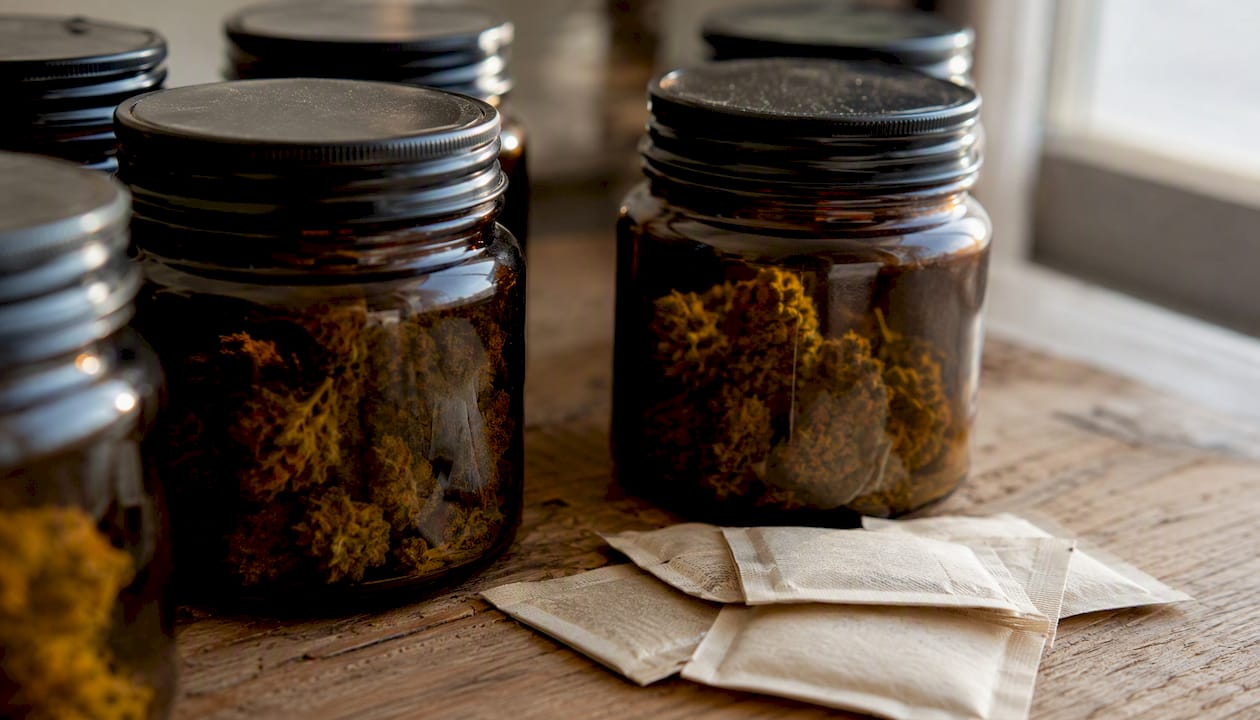
| Hermetically tinted glass jar | Blocks UV, taste neutral, reusable | Fragile, bulky for small quantities |
| Metal or thick plastic opaque box | Lightweight, practical for transport | Do not always block UV according to quality |
| Hygro-regulator bag (Boveda type) | Maintains the target humidity accurately | Recurring cost, to be replaced regularly |
| Manufacturer's original packaging | Designed for the product, practical | Not always airtight after first opening |
| Vacuum setting | Reduces residual oxygen | Specific equipment required |
Boveda bags are particularly useful for consumers who store large quantities of flowers: they automatically maintain moisture in the range 55–62% without daily intervention. For small quantities, a well closed tinted glass jar is sufficient.
Pro Council: If you refrigerate an oil on the recommendation of the manufacturer, let it return to room temperature for 15 to 20 minutes before use. Cold oil is more viscous, making the pipette dosage less accurate.
Freezing is not recommended for most CBD products: it can cause separation of components in oils and weaken flowers when thawing. Reserve it only if explicitly mentioned by the manufacturer.
How to identify that a CBD product has deteriorated?
Some signs are not wrong. Here's what to watch.
Visual signs:
- White, grey or green spots on flowers: proven mould, to be discarded without hesitation.
- Fine whitish powder on flowers (to be distinguished from natural trichome, which is shiny and sticky).
- Oil became cloudy, very dark or with unusual deposit.
- Melted, glued or deformed gums.
Olfactory and textural signs:
- Odour rand, mouldy or ammonia on flowers or oils.
- Flower become too friable and dry, losing its characteristic aromas.
- Abnormally moist and compact to the touch.
Absolute safety rule: If in doubt, do not consume. Isolate the suspect product, discard it, and clean the container before reuse. No lost flavour justifies a health risk.
The procedure is simple: isolate, discard if suspect, then analyze what caused the deterioration (too hot, poorly closed, excessive humidity) so as not to repeat the error.
Sources, expertise and regulatory framework
The recommendations in this article are based on verifiable scientific and regulatory sources.
« The stability of cannabinoids depends directly on storage conditions: temperature, exposure to oxygen and light are the determinants identified in the scientific literature. » Summary from the analysis of cannabinoid degradation research.
Sources consulted:
- How to store and store cbd products: avoid common errors and preserve their quality in light and heat
- How to keep CBD at home: tips for beginners — The Guide to L-Oil Cbd
- How to consume CBD oil: dosing and methods | Natures Garden CBD
- ScienceDirect article on cannabinoid stability
- Legifrance — code article
- I amvapoteur.org
This article provides general information on the conservation of CBD products. It does not constitute a medical or therapeutic opinion. For any therapeutic use, consult a health professional and check the regulations in force with the competent authorities.
Rod is an editor specializing in well-being and cannabinoid products, with particular attention to responsible consumption practices in Europe.
Key points
The golden rule to preserve your CBD products is simple: light, heat and oxygen are their three main enemies, and a sealed jar in a temperate closet is enough to neutralize them.
| Dot | Details |
|---|---|
| Protect from light and heat | Store in a closed closet between 15°C and 25°C, never near a window or radiator. |
| Check moisture for flowers | Hold 55-62% relative humidity with a Boveda bag to avoid mould and drying. |
| Close immediately after use | Each opening introduces oxygen; close without delay to limit oxidation. |
| Identify and dispose of questionable products | Marks, rancid odor or abnormal texture indicate deterioration: do not consume in case of doubt. |
What is often learned too late about CBD conservation
Most guides focus on containers and temperatures. What they rarely say is that the opening frequency counts as much as the container itself. A perfect glass jar opened ten times a day degrades almost as fast as a plastic bag. The real discipline is to take what you need in one opening and close immediately.
The other blind spot concerns flowers purchased in large quantities. Divide its stock into two portions, one for current use and one for long-term storage, radically changes the product's life. The reserve portion, never opened, retains its terpenes and power well beyond the six months usually mentioned. It's a simple habit, but few consumers think about it spontaneously.
Finally, the opening date remains underestimated. The expiry date printed on the packaging assumes an unopened product, stored in ideal conditions. Once the vial is opened, the actual countdown begins. Note this date, and trust your senses as well as the label.
Useful sources and resources
- ScienceDirect study on cannabinoid stability — Scientific reference on the degradation of cannabinoids by heat and oxygen, based on temperature and storage recommendations.
- Legifrance — French legal framework for the labelling and sale of products derived from hemp.
- Natures Garden CBD — concrete recommendations for the conservation and use of sublingual oils.
- Isvapoteur.org — sector councils for the protection of e-liquids against UV and heat.
        </article>
    </body>
    </html>